
Chemistry
|
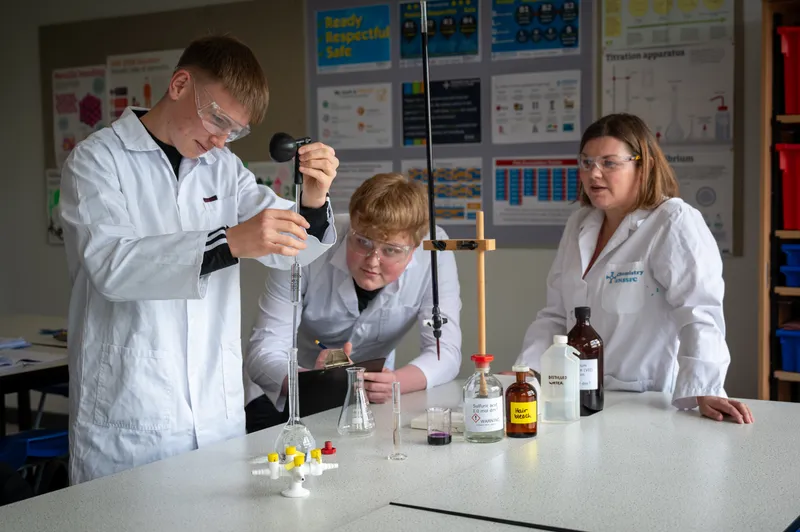
Chemistry at Northallerton School & Sixth Form College develops students’ understanding of matter, reactions and the chemical principles that underpin modern society. Our curriculum is carefully sequenced from Year 7 to Year 13 to build:
Students explore how chemistry explains the properties of materials, environmental change, sustainability and technological innovation. |
 |
Key Stage 3
Curriculum Intent
At Key Stage 3, students develop strong foundations in:
-
Particles and states of matter
-
Chemical reactions and patterns of reactivity
-
Acids and alkalis
-
The periodic table
-
The Earth’s atmosphere and resources
Year 9 acts as a transitional year into GCSE, introducing AQA GCSE specification content to prepare students for either Combined Science or Triple Science pathways.
KS3 Curriculum Overview
| Term | Year 7 | Year 8 | Year 9 (GCSE Transition) |
|---|---|---|---|
| Autumn Term 1 | AA: Acids & Alkalis | CR: Chemical Reactions | CoTA: Chemistry of the Atmosphere |
| Autumn Term 2 | AA: Acids & Alkalis | CR: Chemical Reactions | CoTA: Chemistry of the Atmosphere |
| Spring Term 1 | PART: Particles | PR: Patterns of Reactivity | CoTA: Chemistry of the Atmosphere |
| Spring Term 2 | PART: Particles | PR: Patterns of Reactivity | ASPT: Atomic Structure & Periodic Table |
| Summer Term 1 | EC: Elements & Compounds | RA: Rocks & Atmosphere | ASPT: Atomic Structure & Periodic Table |
| Summer Term 2 | EC: Elements & Compounds | RA: Rocks & Atmosphere | ASPT: Atomic Structure & Periodic Table |
Year 9 introduces core GCSE concepts including quantitative chemistry, atomic structure and energy changes to ensure smooth progression into Key Stage 4.
Key Stage 4 (GCSE Chemistry)
Students study either:
-
Combined Science (Trilogy)
-
Separate Chemistry (Triple Science)
Triple Science includes additional depth in quantitative chemistry, rates of reaction, organic chemistry and chemical analysis.
KS4 Curriculum Overview
| Term | Year 10 (Combined & Triple) | Year 11 (Combined) | Year 11 (Triple Additional Depth) |
|---|---|---|---|
| Autumn Term 1 | BSP: Bonding, Structure & Properties | RECC: Rate & Extent of Chemical Change | ORC: Organic Chemistry |
| Autumn Term 2 | CHC: Chemical Changes | ORC: Organic Chemistry | CA: Chemical Analysis |
| Spring Term 1 | ORC: Organic Chemistry | CA: Chemical Analysis | UR: Using Resources |
| Spring Term 2 | CA: Chemical Analysis | UR: Using Resources | Quantitative Chemistry (Extended) |
| Summer Term 1 | UR: Using Resources | Bespoke QLA-informed Intervention | Extended Practical & Analytical Skills |
| Summer Term 2 | RECC: Rate of Reaction | Bespoke QLA-informed Intervention | Bespoke QLA-informed Intervention |
Year 11 becomes increasingly responsive, with curriculum time directed by Question Level Analysis to maximise examination outcomes.
Sixth Form (Key Stage 5)
We offer A Level Chemistry.
The course develops advanced understanding across:
-
Physical Chemistry
-
Organic Chemistry
-
Inorganic Chemistry
Students complete required practical investigations and develop analytical, mathematical and evaluative skills essential for higher study.
KS5 Curriculum Overview
| Term | Year 12 | Year 13 |
|---|---|---|
| Autumn Term 1 | Atomic Structure & Amount of Substance | Optical Isomerism |
| Autumn Term 2 | Bonding | Aldehydes & Ketones |
| Spring Term 1 | Energetics | Carboxylic Acids & Derivatives |
| Spring Term 2 | Kinetics | Thermodynamics & Kp |
| Summer Term 1 | Introduction to Organic Chemistry | Electrochemistry |
| Summer Term 2 | Organic Chemistry (Alkanes, Alkenes, Alcohols) | Transition Metals & Reactions of Ions |
Further Year 13 study includes:
-
Aromatic Chemistry
-
Amines
-
Polymers
-
Amino Acids, Proteins & DNA
-
NMR and advanced analytical techniques
Literacy, Careers and Personal Development
Across all key stages:
-
Tier 3 chemical terminology is explicitly taught
-
Quantitative literacy is embedded through chemical calculations
-
Practical investigations develop analytical and evaluative writing
-
Sustainability and environmental responsibility are explored
-
Careers links include medicine, engineering, environmental science, pharmaceuticals and materials science
Students develop scientific literacy and critical thinking about how chemistry shapes the modern world.