
Music
|
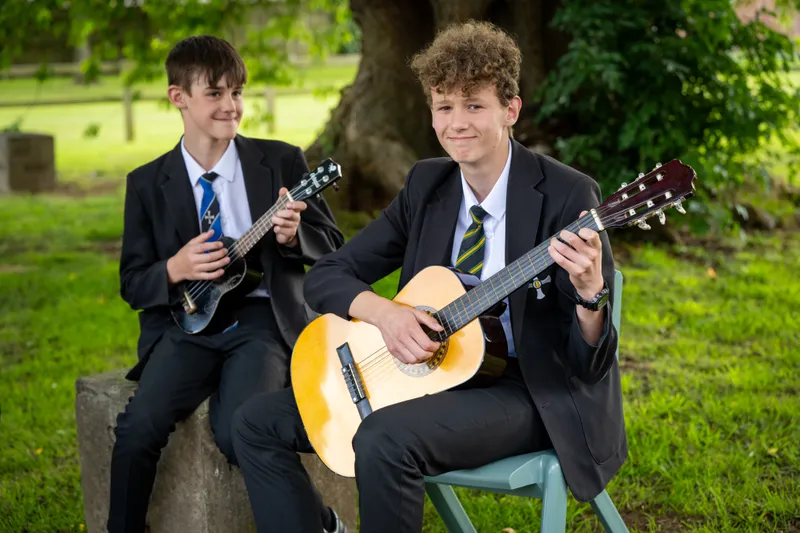
Music at Northallerton School & Sixth Form College develops confident performers, thoughtful composers and analytical listeners. Students explore music practically and theoretically, building technical skill, creativity and critical understanding. Core strands:
The curriculum is carefully sequenced from foundational rhythmic and instrumental skills in Key Stage 3, through to the full GCSE specification at Key Stage 4. Students progressively develop independence, technical accuracy and evaluative depth. Assessment is aligned to Eduqas GCSE assessment objectives, with performance recordings, composition portfolios and listening examinations informing ongoing feedback and targeted intervention. Independent rehearsal, composition refinement and structured listening tasks support long-term musical development. |
 |
View our School Music Development Plan Here
Key Stage 3
Curriculum Intent
At Key Stage 3, students build practical musicianship, theoretical understanding and cultural awareness through performance, composition and listening.
Students develop:
-
Rhythmic accuracy and notation skills
-
Instrumental technique (keyboard, ukulele and percussion)
-
Understanding of musical elements and structures
-
Ensemble performance skills
-
Analytical listening and written evaluation
KS3 Curriculum Overview
| Term | Year 7 | Year 8 | Year 9 |
|---|---|---|---|
| Autumn 1 | Understanding Rhythm | Night Music | Soundtracks (Film Music) |
| Autumn 2 | Keyboard Skills | Off Beat (Reggae) | Samba Carnival |
| Spring 1 | Musical Variations | Saharan Sounds (African Music) | Create a Pop Song |
| Spring 2 | Ukulele Skills | Rock ’n’ Roll | Free Composition |
| Summer 1 | Gamelan Music | Ensemble Performance | GCSE Transition – Theory |
| Summer 2 | Performance Project | Composition Project | GCSE Transition – Listening Skills |
Projects increase in musical complexity each year, with Year 9 strengthening theoretical knowledge and compositional structure in preparation for GCSE study.
Key Stage 4 – GCSE Music (Eduqas)
Students follow the Eduqas GCSE Music specification.
Curriculum Structure
-
Component 1 – Performing (30%)
-
Component 2 – Composing (30%)
-
Component 3 – Listening and Appraising (40%)
-
Study of four Areas of Study:
-
Musical Forms and Devices
-
Music for Ensemble
-
Film Music
-
Popular Music
-
The curriculum is structured to balance practical coursework with listening preparation. QLA from mock examinations informs responsive teaching and bespoke intervention in Year 11.
KS4 Curriculum Overview
| Term | Year 10 | Year 11 |
|---|---|---|
| Autumn 1 | Music Theory & AOS1 | Set Brief Composition |
| Autumn 2 | AOS2 – Music for Ensemble | AOS1 Revision |
| Spring 1 | AOS3 – Film Music | AOS4 Revision |
| Spring 2 | Free Composition | GCSE Revision Programme |
| Summer 1 | Performance Coursework | Bespoke Listening Intervention |
| Summer 2 | Composition Refinement | Final Examination |
Year 11 includes targeted listening practice, extended written responses and structured revision informed by assessment data.
Sixth Form
There is currently no post-16 Music provision.
Literacy, Careers and Personal Development
-
Vocabulary – Explicit teaching of musical terminology including motif, cadence, modulation, texture, structure and stylistic conventions.
-
Knowledge organisers – Area of Study booklets and glossaries support retrieval and exam preparation.
-
Careers links – Performer, composer, producer, music technologist, film composer, music journalist, teacher, ethnomusicologist.
-
SMSC / personal development – Cultural appreciation, collaboration, discipline, resilience, creative self-expression and confidence through performance.