
Technology (Key Stage 3)
|
Technology at NSSFC provides all students with a broad and ambitious experience across design, engineering, electronics, food and manufacturing disciplines. Core strands:
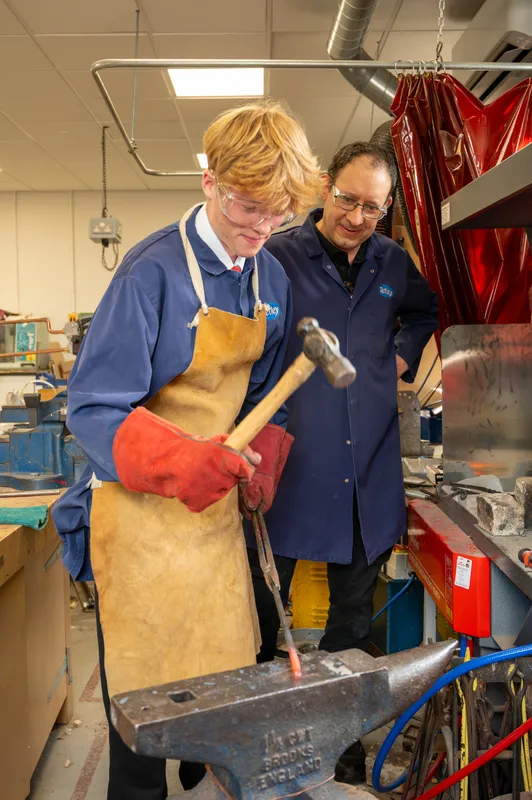
All students study Technology in Years 7, 8 and 9. The subject is delivered through a carousel rotation, ensuring that every student accesses each strand within every academic year. The curriculum is carefully sequenced to build practical competence, technical knowledge and creative confidence. Students move from foundational workshop and food skills in Year 7 to increasingly precise and industry-aligned projects by Year 9. Assessment focuses on the design process, practical accuracy, safety, evaluation and the application of subject-specific vocabulary. Projects increasingly introduce GCSE-level concepts such as specification writing, ACCESS FM analysis, CAD/CAM integration and iterative design. Independent learning is developed through design refinement, evaluation tasks and portfolio-style presentation work. |
 |
Key Stage 3
Curriculum Intent
At KS3, students experience a wide range of materials, tools and processes to build confidence and capability across all Technology disciplines.
Students develop:
-
Safe and competent workshop practice
-
CAD and digital manufacturing skills
-
Understanding of materials and their properties
-
Electronics fundamentals
-
Food preparation and nutrition knowledge
-
Iterative design and evaluation skills
The carousel ensures breadth, while increasing technical challenge each year.
KS3 Curriculum Overview
| Term | Year 7 | Year 8 | Year 9 |
|---|---|---|---|
| Autumn 1 | Textiles – Day of the Dead | Headphone Stand (Metal & Timber) | Tealight Holder (CAD/CAM & Wood) |
| Autumn 2 | Spatula Project (Timber & Workshop Skills) | 3D Modelling & Printing | Phone Holder (Engineering Drawing & Metal) |
| Spring 1 | Torch Project (Electronics & Soldering) | Mood Light (Electronics & CAD) | Coat Hook (Sheet Metal & Finishing) |
| Spring 2 | Food – Introduction to Food | Food – Provenance & Nutrition | Street Food Project |
| Summer 1 | Food – Practical Skills | Food – Production & Evaluation | Cuisines & Cake Methods |
| Summer 2 | Lamp Project (Design & Manufacture) | Mini Food Rotation | Clock Project (CAD & Manufacture) |
Each project builds:
-
Increasing precision
-
Greater independence
-
Higher expectations of evaluation
-
Application of industry vocabulary
-
Understanding of sustainability and material choice
Year 9 projects explicitly prepare students for GCSE-level Design & Technology, Engineering and Food pathways.
Key Stage 4
At the end of Year 9, students choose from specialist Technology pathways including:
-
GCSE Design & Technology
-
NCFE Engineering
-
Food Preparation & Nutrition
-
Hospitality & Catering
Each pathway builds on the foundational skills developed during the KS3 carousel.
Sixth Form
Post-16 opportunities in Technology-related disciplines are available through vocational and academic routes depending on option uptake. Students are supported in progressing into apprenticeships, technical pathways and STEM-related careers.
Literacy, Careers and Personal Development
Vocabulary
Students develop secure understanding of tier 3 terminology including CAD, CAM, orthographic projection, tolerance, sustainability, iteration, ferrous, non-ferrous, hygiene, macronutrients and specification writing.
Knowledge Organisers
Each project is supported by structured glossaries and process guides to reinforce key knowledge and technical language.
Careers Links
The KS3 Technology curriculum introduces students to a wide range of careers including:
-
Product designer
-
CAD technician
-
Mechanical engineer
-
Furniture maker
-
Electrician
-
Food technologist
-
Chef
-
Quality assurance technician
-
Manufacturing engineer
Students gain insight into apprenticeships, T-levels and technical qualifications.
SMSC / Personal Development
Technology supports:
-
Moral understanding of sustainability and responsible material use
-
Social collaboration in shared workshop and kitchen environments
-
Spiritual reflection through creative expression and pride in craftsmanship
-
Cultural awareness through food, textiles and global design influences
The carousel builds resilience, independence, precision, teamwork and problem-solving — key characteristics for both academic and vocational success.