
Food Preparation and Nutrition
|
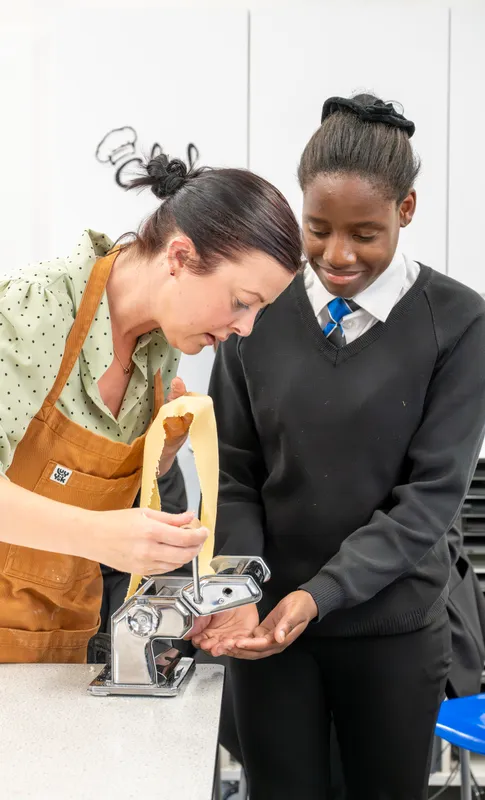
Food Preparation and Nutrition at NSSFC develops practical competence, scientific understanding and independence in the kitchen. Students explore food provenance, nutrition, food science and high-level culinary skills while applying theory to real-world contexts. Core strands:
The curriculum is sequenced to build from KS3 practical foundations into increasingly scientific and evaluative GCSE-level study. Year 10 establishes core knowledge and technical skill; Year 11 focuses on the two Non-Exam Assessments (NEA) and examination preparation. Assessment includes:
QLA informs responsive reteaching, particularly in food science processes, command word interpretation and extended evaluation. Independent learning includes research, planning documentation, trial evaluation and structured revision. |
 |
Key Stage 3
All students study Food as part of the KS3 Technology carousel. This provides the foundational skills required for GCSE study.
Students develop:
-
Safe and hygienic food preparation
-
Knife skills and cooking techniques
-
Understanding of nutrition and balanced diets
-
Cultural and global food awareness
-
Evaluation and reflection skills
KS3 builds confidence, resilience and technical accuracy in preparation for GCSE-level independence.
Key Stage 4 – GCSE Food Preparation and Nutrition
Students follow the Eduqas GCSE Food Preparation and Nutrition specification.
Curriculum Structure
-
Unit 1 – Food Security
-
Unit 2 – Mini NEA (Preparation for formal NEA)
-
Unit 3 – Food Commodities and Food Science
-
NEA 1 – Food Investigation
-
NEA 2 – Food Preparation Task
-
Written Examination
KS4 Curriculum Overview
| Term | Year 10 | Year 11 |
|---|---|---|
| Autumn 1 | Unit 1 – Food Security | NEA 1 – Food Investigation |
| Autumn 2 | Unit 1 – Food Security (continued) | NEA 1 Completion & Analysis |
| Spring 1 | Unit 2 – Mini NEA | NEA 2 – Food Preparation Task |
| Spring 2 | Unit 3 – Food Commodities & Science | NEA 2 Completion & Evaluation |
| Summer 1 | Unit 3 – High-Level Practical Skills | Written Examination Preparation |
| Summer 2 | Practical Skill Consolidation & Evaluation | Final Examination |
Year 11 includes structured revision cycles, command word practice and targeted intervention based on mock analysis.
Sixth Form
A KS5 Food-related pathway is planned for introduction next academic year. This will extend students’ knowledge into advanced nutrition, food science and industry-based applications, building directly from the GCSE course.
Details of the KS5 offer will be confirmed in line with option uptake and staffing structure.
Literacy, Careers and Personal Development
Vocabulary
Students develop precise disciplinary terminology including emulsification, gelatinisation, denaturation, coagulation, sensory profile, dovetailing and sustainability.
Knowledge Organisers
Each unit includes structured glossaries and organisers to support retrieval, NEA planning and exam revision.
Careers Links
The curriculum introduces pathways including:
-
Chef and catering management
-
Food scientist
-
Nutritionist
-
Product development technologist
-
Environmental health officer
-
Sensory analyst
-
Hospitality and event management
Students engage in real-world style tasks including recipe development, evaluation and professional presentation.
SMSC / Personal Development
Students develop:
-
Ethical awareness of food security and sustainability
-
Cultural appreciation through global cuisine
-
Resilience through trial and refinement
-
Independence and time management
-
Responsibility through hygiene and food safety
Through practical independence and structured evaluation, students build confidence, pride and professional standards aligned to both further education and employment.