
Physics
|
Physics at Northallerton School & Sixth Form College develops students’ understanding of the fundamental laws that govern the universe - from forces and energy to fields, waves and particle physics. Our curriculum is carefully sequenced from Year 7 to Year 13 to build:
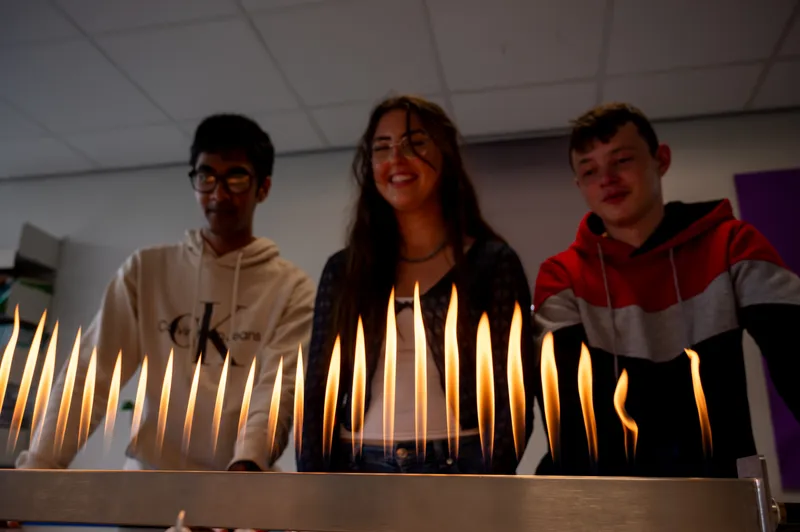
Students explore how physics explains motion, energy transfer, electricity, magnetism, space and the structure of matter. |
 |
Key Stage 3
Curriculum Intent
At Key Stage 3, students build strong foundations in:
-
Forces and motion
-
Energy transfer
-
Electricity and magnetism
-
Waves
-
Earth and space
Year 9 acts as a transitional year into GCSE, introducing core GCSE content and mathematical application to prepare students for Combined Science or Triple Science pathways.
KS3 Curriculum Overview
| Term | Year 7 | Year 8 | Year 9 (GCSE Transition) |
|---|---|---|---|
| Autumn Term 1 | ES: Earth & Space | M&S: Motion & Speed | PMM: Particle Model of Matter |
| Autumn Term 2 | FO: Forces | SLW: Sound, Light & Waves | PMM: Particle Model of Matter |
| Spring Term 1 | NRG: Energy | ELEC: Electricity | PMM: Particle Model of Matter |
| Spring Term 2 | CIRC: Electrical Circuits | ELEC: Electricity (extended) | Energy (EN) |
| Summer Term 1 | MAG: Magnetism | FO: Forces | Energy (EN) |
| Summer Term 2 | IEP: Internal Energy & Particles | NRG: Energy | Energy (EN) |
Year 9 introduces GCSE-level equations, required practical elements and extended mathematical reasoning to ensure readiness for Key Stage 4.
Key Stage 4 (GCSE Physics)
Students study either:
-
Combined Science (Trilogy)
-
Separate Physics (Triple Science)
Triple Science includes additional depth in Forces, Electricity, Waves and Space Physics.
KS4 Curriculum Overview
| Term | Year 10 (Combined) | Year 10 (Triple) | Year 11 (Combined) | Year 11 (Triple) |
|---|---|---|---|---|
| Autumn Term 1 | AST: Atomic Structure | AST: Atomic Structure (extended) | FAM: Forces & Motion | FAM: Forces & Motion (extended) |
| Autumn Term 2 | AST: Atomic Structure | AST: Atomic Structure | FAM: Forces & Motion | FAM: Forces & Motion |
| Spring Term 1 | Electricity | Electricity(extended) | Space Physics | Magnetism (extended) |
| Spring Term 2 | Electricity | Electricity (extended) | Space Physics | Space Physics (extended) |
| Summer Term 1 | Waves | Waves (extended) | Bespoke QLA-informed Intervention | Bespoke QLA-informed Intervention |
| Summer Term 2 | Magnitism (& Revision) | Waves (& Revision) | Bespoke QLA-informed Intervention | Bespoke QLA-informed Intervention |
Year 11 becomes increasingly responsive, with curriculum time directed by Question Level Analysis to maximise examination outcomes.
Sixth Form (Key Stage 5)
We offer A Level Physics.
The course develops advanced understanding across:
-
Particles and radiation
-
Waves
-
Mechanics
-
Electricity and magnetism
-
Thermal physics
-
Fields
-
Nuclear physics
Students develop strong mathematical modelling skills and complete required practical investigations.
KS5 Curriculum Overview
| Term | Year 12 | Year 13 |
|---|---|---|
| Autumn Term 1 | Introduction to A Level Physics & Particle Physics | Capacitors |
| Autumn Term 2 | Electricity | Electric Fields |
| Spring Term 1 | Dynamics | Gravitational Fields |
| Spring Term 2 | Waves | Thermal Physics & Gas Laws |
| Summer Term 1 | Materials & Circular Motion | Nuclear Physics |
| Summer Term 2 | Revision & Practical Skills | Electromagnetism & Turning Points |
Year 13 includes extended mechanics, fields and quantum phenomena, developing conceptual and mathematical sophistication in preparation for university study.
Literacy, Careers and Personal Development
Across all key stages:
-
Tier 3 physics vocabulary is explicitly taught and revisited
-
Mathematical fluency is embedded through equation manipulation
-
Required practical investigations develop analytical writing and evaluation
-
Ethical discussions include nuclear energy, sustainability and space exploration
-
Careers links include engineering, astrophysics, medical physics, renewable energy and aerospace
Students develop resilience, problem-solving skills and an understanding of physics’ role in shaping modern society.